Watchtower: A Machine For Living
James Coupe
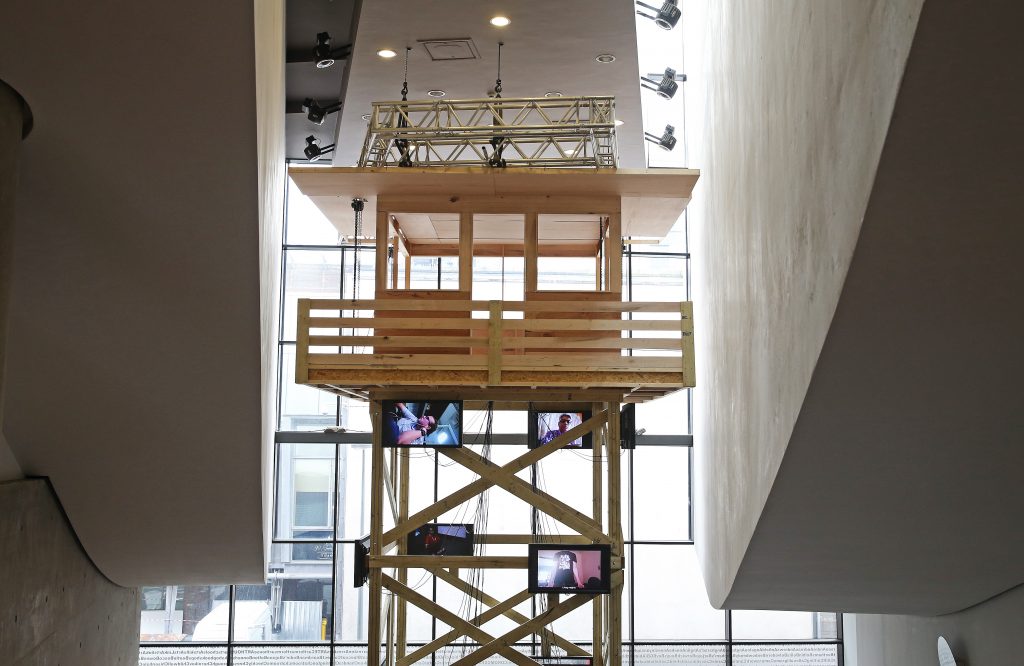
Watchtower is a four-storey wooden tower, modeled after the fire lookout towers found in the rural areas surrounding the artist’s home in Seattle. Most of these towers are now tourist attractions, a signal of the shifting nature of observation. Today, the apparatus of observation is not architectural, but networked, a series of cameras, sensors, and algorithms that have replaced the watchtower and its human occupants. Surveillance is no longer an external mechanism, but a domesticated one, seamlessly integrated into the rituals and environments of home, work and leisure.
A hybrid of architectural and networked surveillance, the cabin at the top of Watchtower contains a bank of computers that are programmed to manage an Amazon Mechanical Turk (mTurk) account. MTurk is an on-demand task management service (or system) that allows account holders to hire human workers to complete small-scale tasks (surveys, captcha identification, basic image analysis) that computers cannot successfully perform (or at least, not yet); Amazon refers this service as “artificial artificial intelligence,” since the workers remain isolated, invisible and anonymous, like proletarianized ghosts in the machine.
Watchtower’s computers are programmed to request mTurk workers to upload videos, to pay the workers, and then to process the videos it receives. The workers were asked to film themselves engaging in activities that hover between work and leisure – for instance, describing the view from their windows, praying, or predicting the future. Other videos mimic social media conventions, and document the workers’ meals, exercise routines, even narrating last night’s dreams.
The tower is flanked by sixteen monitors displaying the resulting videos, selected from an expanding database of thousands, which are continuously uploaded by the workers. Documenting the daily lives of mTurk’s invisible workforce, Watchtower transforms into a kind of clock, organizing the work day according to a ritualized set of mundane activities.
About the artist
James Coupe is a Seattle-based artist who works with video, installation, internet, and emerging media forms. His work includes real-time public surveillance systems, interactive deepfake installations, and collaborations with Amazon Mechanical Turk micro-laborers. Reflecting on the impact of Big Data, immaterial labor and AI, Coupe’s art works explore searches, queries, automation, classification systems, the use of algorithmic narratives, surplus value and human affect. He is Head of Photography and Professor of Art and Experimental Media at the Royal College of Art in London.
Notable projects include “Sanctum” (2013), an interactive public artwork exhibited for two years on the facade of the Henry Art Gallery; his Creative Capital project, “Swarm” (2013), which was exhibited at both ZKM and The Museum of Contemporary Canadian Art / Toronto International Film Festival, and received an Honorable Mention for Interactive Art at the Prix Ars Electronica; “General Intellect” (2015), exhibited at Aktionsart, and which received the HeK Award for net-based art; “Watchtower”, exhibited at FACT, and recipient of the Surveillance Studies Network Arts Fund Award; and “Warriors”, which was the inaugural exhibition at the new International Center of Photography (ICP) museum in New York City.